 By
By 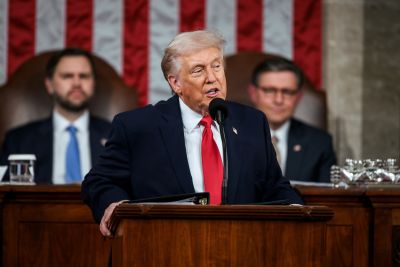
President Donald Trump used his 2026 State of the Union address on February 24 to present an extensive overview of his administration's past year and to map out a broad policy agenda for the coming months before a joint session of Congress. Speaking in the U.S. Capitol, he framed the speech as both a progress report and a forward-looking blueprint touching nearly every major area of domestic and foreign policy.
The president devoted significant time to economic policy, emphasizing efforts to spur growth and job creation through expanded incentives for manufacturing and domestic energy production. He highlighted proposed tax and regulatory measures aimed at small and mid-size businesses, positioning them as central to investment, innovation, and employment in local communities across the country.
Infrastructure was another major pillar of the address. Trump called for new federal and state-backed initiatives to upgrade highways, bridges, ports, and broadband networks, describing modernization of transportation and digital connectivity as necessary for long-term competitiveness. The proposals envisioned a mix of public funding and private-sector participation to accelerate project timelines and extend coverage to underserved regions.
On healthcare and public health, the president outlined plans to increase access to telehealth services, particularly in rural and low-access areas, and to pursue steps intended to lower prescription drug costs. He also stressed the importance of improving federal preparedness for future public health emergencies, referencing investments in surveillance systems, strategic stockpiles, and coordination with state and local authorities.
National security and border policy featured prominently, with commitments to enhance border infrastructure and strengthen immigration enforcement while maintaining support for U.S. military readiness. The administration's approach included additional resources for border technology and personnel, along with continued funding for defense modernization and support for service members stationed abroad.
In the realm of trade and international relations, Trump reiterated a focus on revising existing trade agreements and applying targeted tariffs in cases the administration considers critical to protecting domestic industries. He framed these measures as part of a broader effort to maintain competitive markets, support U.S. manufacturing, and address perceived imbalances in global trade relationships.
Analysts observing the address noted that it ran longer than typical State of the Union speeches, allowing for more detailed explanations of the administration's priorities and policy mechanics. Reaction within Congress was mixed, with responses largely tracking existing partisan and ideological divisions over spending levels, regulatory policy, and the scope of executive authority.
For many observers in Washington and beyond, the speech functioned as both a summation of the administration's recent actions and a clear signal of its legislative and regulatory agenda heading into the remainder of 2026. Coverage across news outlets underscored how the address sought to communicate directly to lawmakers and the public, setting expectations for upcoming debates over the economy, infrastructure, healthcare, national security, and trade.